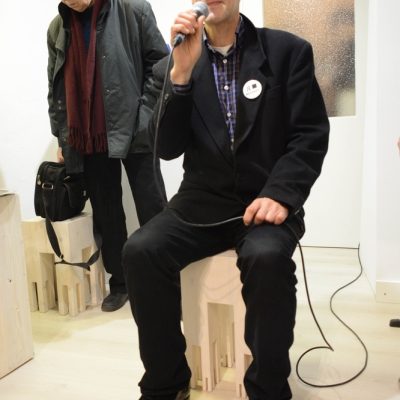
2025-10-22 | K28 Galéria, Budapest
Kurátorok: T. Michael Stephens / A.R.C. Group | Saxon Szász János / Saxon Art Gallery


Fotók / Photos: Judith Cisneros
Saxon Szász János megnyitó beszéde
Pár évvel ezelőtt Michael T. Stephens, az Art Research Center egyik alapító tagja megkeresett azzal a kéréssel, hogy rendezzünk kiállítást az ARC ötvenedik évfordulójára a Saxon Art Galériában. Akkor a galéria már más programokra volt lekötve, majd időközben átmenetileg felfüggesztette a kiállítások szervezését a fix kiállítóterében, így sajnos nem tudtuk megvalósítani ezt a tervet.
Michael azonban nem adta fel álmát, hogy az Art Research Center – ez a különleges, nemzetközi konstruktív művészeti közösség – Budapesten is bemutatkozhasson. Nemrég újra megkeresett, hogy ünnepeljük meg az ARC 55. évfordulóját. A felvetést rövidre zárva, megkerestem a K28 Galériát, Kontur Balázst, aki vállalta a kiállítás megrendezését. A K28 Galéria közössége ugyanazon gyökerekből táplálkozik: Kassák Lajos, Fajó János, a nemzetközi MADI mozgalom, és természetesen a geometrikus és konstruktív művészet szabad, kutató szelleme inspirálja.
Az Art Research Center (A.R.C.) az 1960-as években Kansas Cityben alapított non-profit konstruktív–strukturális művészeti közösség, amely működésének alapját az interdiszciplináris (képzőművészet, design, zene, irodalom, építészet, elmélet) együttműködésekben látja. Az A.R.C. saját meghatározása szerint a Moholy-Nagy által megálmodott „Fényintézet” szellemi örökségét folytatja: kísérleti, percepciókutató, rendszeralapú művészeti gyakorlatokat valósít meg – kiállítások, performanszok, előadások és publikációk formájában.
A csoport első nagy kiállításai a ’60-as évek közepén zajlottak, majd 1969-ben és 1973-ban Zágrábban is szerepeltek a New Tendencies (Nove Tendencije) nemzetközi hálózatában. Ez a platform kulcsszereplője volt az európai op-art, kinetikus és számítógépes művészet kibontakozásának. A csoport azóta is aktív: öt és fél évtizede dolgozik azon, hogy a művészet, a tudomány, a technológia és az érzékelés új kapcsolódási pontjait kutassa – installációkon, digitális műveken, fény- és térkonstrukciókon keresztül.
A mai kiállítás ezt a hosszú, összekapcsolódó történetet mutatja be: az amerikai és európai konstruktív hagyomány közös nyelvét, amely az orosz konstruktivizmusból, Kassáktól és Moholy-Nagytól indul, és a MADI-n keresztül a geometrikus absztrakció, valamint az új médiaművészet formanyelveiben él tovább.
A Michael Stephens-szel folytatott telefonbeszélgetések során felmerült az is, hogy ilyen hosszú időn át – immár 55 éve – működő alkotóközösség szinte egyedülálló a művészettörténetben. Talán ezt is érdemes megemlíteni.
Ez az este nemcsak egy kiállítás megnyitója, hanem egy szellemi találkozás is: híd múlt és jövő, kontinensek és művészeti szemléletek között. Reméljük, hogy e két alkotóközösség egymásra talál, és a következő kiállításokon már kibővülve, a K28 Galéria tagjaival kiegészülve mutatkozik be a kontinensen.
A K28 Galéria örömmel ad otthont ennek a jubileumi eseménynek, amelyen az ARC tagjai, külföldi művészek állítanak ki együtt – köztük Judith, Barbara és Gerda, akik személyesen is eljöttek, hogy velünk ünnepeljenek. Készültem egy kis ajándékkal számukra: a MADI Art Periodical történelmi lapszámával, amelyet a KASSÁK és a MADI MA magyar–szlovák összművészeti fesztivál alkalmából adtunk ki 2002-ben. Az eseménysorozat Budapesten, Pozsonyban és Érsekújváron valósult meg, abban a városban, ahol Kassák is született. Mellesleg megemlítem, hogy az érsekújvári Kassák Múzeumban jelenleg is látható Viktor Hulik és Saxon PERTU című kiállítása, és holnap 17 órakor lesz a záró tárlatvezetés a művészekkel. Mindenkit szeretettel várunk oda is!
A konstruktív művészet ma is él – kutat, kérdez, formát keres, épít –, és pontosan ez az az örökség, amelyet az Art Research Center ötvenöt éve képvisel, és amelyhez a magyar hagyományok is szervesen kapcsolódnak.
Építsük tovább együtt a világot, és teremtsünk új, jobb világot a művészet erejével!

Opening speech of János Szász Saxon
A few years ago, Michael Stephens, one of the founding members of the Art Research Center, approached me with the idea of organizing an exhibition at the Saxon Art Gallery to celebrate the 50th anniversary of the ARC. At that time, the gallery was already committed to other programs, and later, it temporarily suspended exhibitions in its fixed exhibition space, so unfortunately, we were unable to realize that plan.
However, Michael did not give up his dream: that the Art Research Center – a unique international community of constructive art – should also be presented in Budapest. Recently, he reached out again, this time to celebrate the 55th anniversary of the ARC. Taking up the idea, I contacted K28 Gallery and Balázs Kontur, who generously agreed to host the exhibition. The K28 Gallery community shares the same roots: it is inspired by Lajos Kassák, János Fajó, the international MADI movement, and above all, the free, exploratory spirit of geometric and constructive art.
The Art Research Center (A.R.C.), founded in the 1960s in Kansas City, is a non-profit community for constructive–structural art. Its foundation lies in interdisciplinary collaborations – across visual art, design, music, literature, architecture, and theory. According to its own definition, ARC continues the intellectual legacy of the „Light Workshop” envisioned by László Moholy-Nagy: implementing experimental, perception-focused, system-based artistic practices – through exhibitions, performances, lectures, and publications.
The group held its first major exhibitions in the mid-1960s, and in 1969 and 1973, it also participated in the international New Tendencies (Nove Tendencije) network in Zagreb. This platform was a key player in the development of European Op-Art, kinetic art, and computer art. The group has remained active ever since: for five and a half decades, it has explored new intersections of art, science, technology, and perception—through installations, digital works, and light- and space-based constructions.
Today’s exhibition presents this long and interconnected story: the shared language of the American and European constructive traditions, which originate from Russian Constructivism, from Kassák and Moholy-Nagy, continuing through MADI into the visual vocabulary of geometric abstraction and new media art.
During my phone conversations with Michael Stephens, we also reflected on the fact that an artistic community that has remained active for 55 years is almost unprecedented in art history. This, too, is worth noting and celebrating. This evening is not just the opening of an exhibition – it is also a meeting of minds: a bridge between past and future, between continents and artistic philosophies. We hope that these two artistic communities have found each other, and that future exhibitions will be even more expansive, incorporating members of the K28 Gallery.
K28 Gallery is honored to host this jubilee event, where members of ARC and international artists are exhibiting together – among them Judith, Barbara and Gerda, who are here with us in person to celebrate. I’ve prepared a small gift for them: a historic issue of the MADI Art Periodical, published on the occasion of the Hungarian–Slovak interdisciplinary arts festival KASSÁK and MADI TODAY in 2002. The festival took place in Budapest, Bratislava, and Nové Zámky – the city where Kassák was born. As a side note, I’d also like to mention that the exhibition Viktor Hulik and Saxon PERTU is currently on display at the Kassák Museum in Nové Zámky, and the closing guided tour with the artists will take place tomorrow at 5 PM. Everyone is warmly welcome to attend!
Constructive art is very much alive today – it explores, questions, seeks form, builds – and this is precisely the legacy that the Art Research Center has represented for 55 years, a legacy that is deeply intertwined with Hungarian traditions.
Let us continue building the world together – and create a new, better one through the power of art!